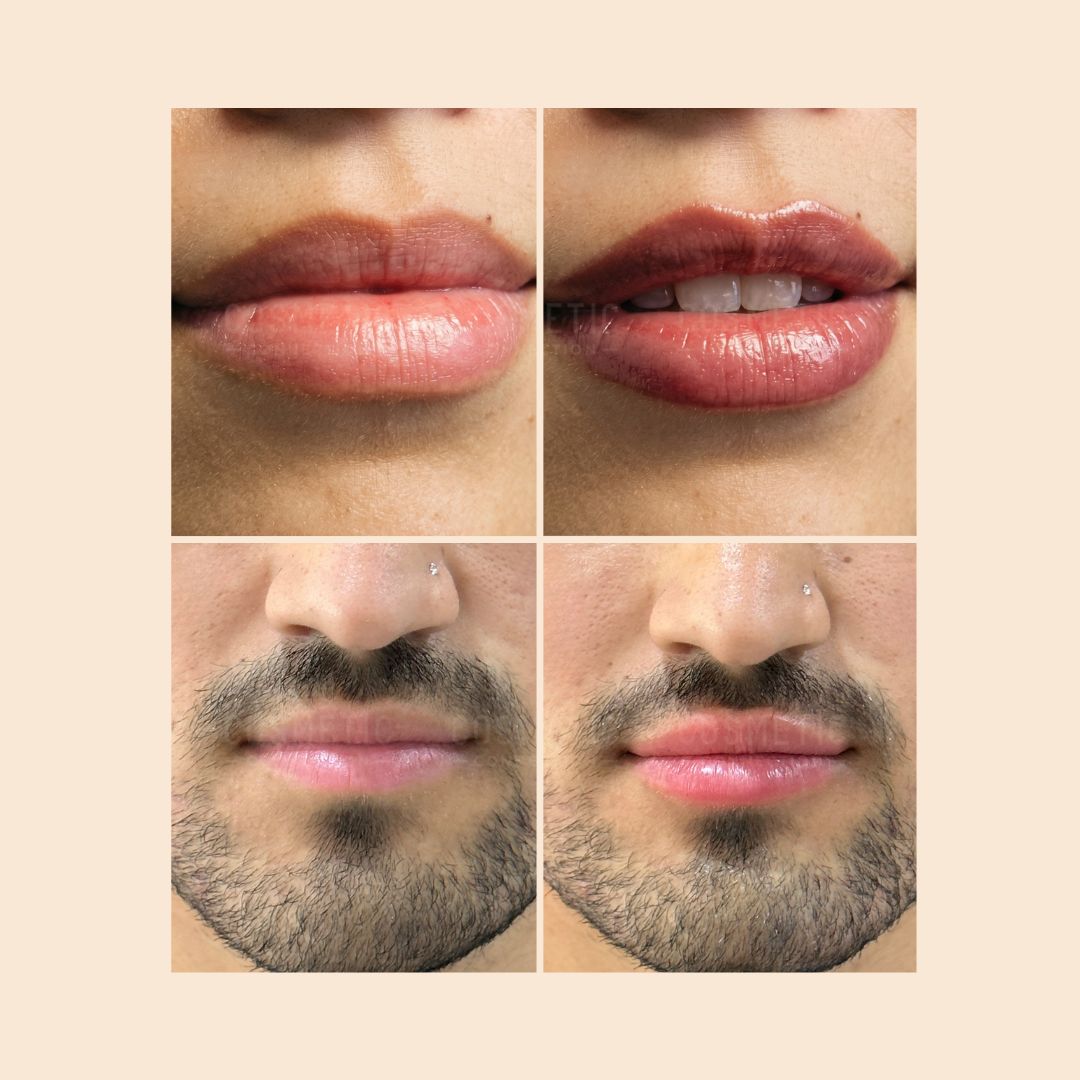
Lip filler is one of the most searched cosmetic treatments treatments in Australia, and one of the most misunderstood. This educational guide covers the complete picture: what lip filler is, what hyaluronic acid is and how it works, what lip filler can and cannot achieve, how long results last, what the risks are, what it costs across Australia, how to get a natural result, and how to find a qualified provider. It is written as a comprehensive clinical reference for anyone researching this topic in depth.
Quick answer: Lip filler refers to the injection of a hyaluronic acid-based gel into and around the lips to add volume, improve shape, and enhance definition without surgery. Results are immediate, last 12 to 18 months, and are fully reversible using an enzyme called hyaluronidase. In Australia, lip filler is a prescription-only substance that must be administered under appropriate medical supervision.
What is lip filler?
Lip filler is the colloquial term for a cosmetic treatments procedure using a hyaluronic acid-based gel to modify the volume, shape, and definition of the lips. Hyaluronic acid (HA) is a naturally occurring glycosaminoglycan — a long-chain sugar molecule — found throughout the body’s connective tissue. When formulated as a cosmetic injectable, it is cross-linked through a chemical process that determines its density, elasticity, cohesivity, and longevity.
The formulation used for lip filler is specifically engineered for the lips: softer and more pliable than formulations used in structural areas like the nasal bridge or chin, because the lips are a high-movement area and a firmer product would feel unnatural and break down faster under the constant motion of speaking and eating.
Lip filler is also known as lip augmentation, lip injections, dermal filler for the lips, or hyaluronic acid lip filler. All refer to the same treatment category. It is distinct from the lip flip (a neuromodulator treatment to the orbicularis oris muscle that everts the upper lip without adding volume) and from PDO thread lip treatment, which uses dissolvable threads rather than gel.
For a broader overview of all non-surgical lip treatment categories — including Rejuran and PDO threads — see our comprehensive guide to non-surgical lip enhancement.
What lip filler can and cannot achieve
Lip filler works through the addition of volume. It does not remove tissue, alter muscle function, or structurally change bone or cartilage. This distinction defines both what it can and cannot achieve.
| Concern | Mechanism | Realistic outcome |
|---|---|---|
| Thin lips | Hyaluronic acid gel placed through the body of the lip adds volume | Meaningful, proportionate volume increase; improved lip-to-face balance |
| Undefined vermillion border | Precise placement at the lip edge creates definition | Sharper, more defined lip outline without significant volume addition |
| Lip asymmetry | Targeted volume to the smaller or flatter side | Meaningful correction of mild to moderate asymmetry |
| Age-related volume loss | Restores lost tissue volume and redrapes overlying skin | Refreshed, restored appearance |
| Downturned lip corners | Targeted placement at the oral commissures lifts the corner | Subtle but visible improvement in perceived resting expression |
| Flat cupid’s bow | Volume placed centrally defines the upper lip peaks | More pronounced upper lip architecture and definition |
| Vertical lip lines | Superficial placement softens perioral lines | Mild to moderate improvement; combination with neuromodulators often optimal |
What lip filler cannot achieve:
- Permanent volume increase
- Physical alteration of lip muscle or underlying oral anatomy
- Correction of significant structural asymmetry
- Improvement in lip skin pigmentation or colour
- Reduction in lip size — filler adds, it does not remove
How does lip filler work? The procedure step by step
- Consultation and assessment: the practitioner examines lip anatomy — volume distribution, upper-to-lower ratio, vermillion border, symmetry, and facial proportions — and discusses goals, realistic outcomes, and risks to determine suitability
- Treatment planning: injection points, product selection, and volume are mapped based on individual anatomy and goals
- Anaesthetic: numbing cream or injections are applied for approximately 10 minutes; most lip filler formulations also contain lidocaine within the product
- Injection: 5-15 minutes; multiple small injections placed at anatomically determined points using needle, cannula, or both
- Real-time assessment: symmetry and volume assessed from multiple angles; minor adjustments made during the procedure
- Aftercare and review: written aftercare provided; follow-up appointment scheduled
How long does lip filler last?
Lip filler results typically persist for 12 to 18 months. The lips break down hyaluronic acid filler faster than most other facial areas because of constant movement from speaking, eating, and facial expression.
| Factor | Effect on longevity |
|---|---|
| Product density and cross-link level | Higher density = longer duration |
| Volume administered | Higher volume = generally longer duration |
| Individual metabolism | Faster metabolism = shorter duration |
| Prior treatment history | Residual product from prior sessions extends effective longevity |
For a detailed breakdown of all factors affecting longevity, see our guide to how long lip enhancement results last.
Lip filler volumes: 0.5ml vs 1ml vs 2ml
Volume is the most commonly asked-about parameter before a first lip filler appointment. The volume numbers refer to the amount of hyaluronic acid gel administered in a single session, measured in millilitres.
| Volume | Best suited to | Typical outcome |
|---|---|---|
| 0.25ml | Very subtle first-time treatment | Very subtle texture improvement |
| 0.5ml | First-time patients with small lips; subtle enhancement | Minimal change |
| 1ml | Patients with thin lips; those building on prior treatment; specific shape goals | Meaningful, visible result; can look natural or noticeable depending on technique |
| 1.5ml–2ml | Volume restoration goals; significant asymmetry; experienced patients | Substantial change; requires experienced injector to maintain natural appearance |
For the complete guide to volume decision-making, see our detailed post on lip enhancement treatment volumes.
Lip filler techniques: Russian, classic, and more
The technique used to administer lip filler significantly influences the shape, distribution, and quality of the result. The main techniques used in Australian clinics are:
- Classic volumising: product distributed through the body of both lips for overall fullness
- Border definition: precise placement at the vermillion border for definition without significant volume
- Russian technique: vertical injection approach creating central height and projection; pronounced cupid’s bow; less lateral spread
- Cupid’s bow enhancement: targeted volume at the peaks of the upper lip
- Holistic peri-oral approach: multiple techniques tailored specifically to the entire lip region — most common in experienced hands
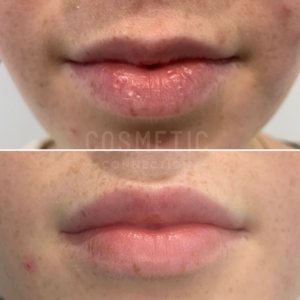
Before and after classic lip volume.
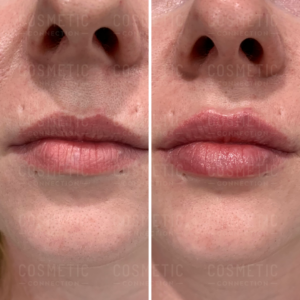
Before and after Cupid’s bow definition.
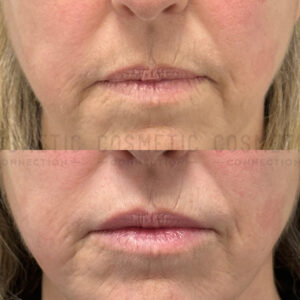
Results of a holistic peri-oral approach.
For a complete explanation of each technique, see our guide to lip enhancement techniques.
Get started
What are the risks of lip filler?
Lip filler is a medical procedure and carries real risks. The lips are a higher-risk site for injectable treatments due to the density of the labial vasculature. The superior and inferior labial arteries present specific vascular risk that practitioners performing lip filler must be trained to manage.
| Complication | Incidence | Management |
|---|---|---|
| Bruising | Common — 10–20% | Resolves 3–5 days |
| Swelling | Universal — expected | Peaks 24 hours; resolves 3–7 days |
| Asymmetry | Temporary — common; persistent — uncommon | Review at 2 weeks; correction or reversal |
| Lumps | Uncommon with correct technique | Review; massage or dissolution if persistent |
| Migration | Uncommon with conservative volumes | Dissolution and re-treatment |
| Infection | Rare | Antibiotics; medical review |
| Granuloma | Rare | Medical assessment; steroid or dissolution |
| Vascular occlusion | Rare — most serious | Immediate reversal; emergency management |
For the complete risk guide, see our post on lip enhancement risks and complications.
Is lip filler reversible?
Yes. Hyaluronic acid lip filler is fully reversible using an enzyme that catalyses the breakdown of the cross-linked gel. When injected into the treated area, dissolution is largely complete within 24 to 48 hours. The lips return to their natural pre-treatment baseline.
This reversibility distinguishes hyaluronic acid filler from permanent or semi-permanent alternatives — including PMMA, silicone, and calcium hydroxylapatite used off-label. None of these should be used in the lips; complications from these products cannot be reversed and have produced severe long-term outcomes in documented cases.

Before and after lip dissolving.
For the complete dissolution guide, see our post on reversing lip enhancement treatments.
How much does lip filler cost in Australia?
| Volume | National price range | Sydney | Melbourne |
|---|---|---|---|
| 0.5ml lip filler | $350 – $600 | $400 – $600 | $400 – $600 |
| 1ml lip filler | $500 – $950 | $550 – $950 | $500 – $950 |
Lip filler is not covered by Medicare or private health insurance. For a full pricing guide, see our post on lip enhancement costs in Australia.
What natural lip filler actually looks like
“Natural lip filler” is the most commonly searched term for people considering this treatment — and for good reason. Unnatural results are what most patients fear. The key insight is that unnatural results are almost always the product of excess volume and incorrect placement, not an inherent property of the treatment.
Natural-looking lip filler results share consistent characteristics: proportionate volume relative to the face, preserved natural lip shape, a defined but soft border, natural movement with expression, and an appropriate upper-to-lower lip ratio with the lower lip remaining fuller than the upper.
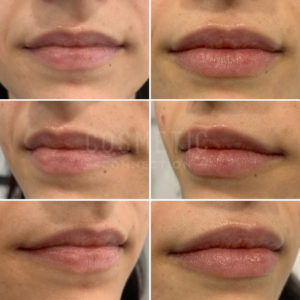
Before and after natural lip injections.
For the complete guide, see our post on what natural lip enhancement actually looks like.
How big will my lips be after treatment?
This depends on your starting size, and the amount and type of treatment you have. Most people notice a subtle change with their first session. In the first few days after, the swelling will allow you to experience a bigger change: if you like the swelling, then consider an additional session. If the swelling is too much change for you, allow it to settle and switch to maintenacne.
Lip filler swelling: day-by-day timeline
Swelling after lip filler is expected and temporary. It peaks at 24 to 48 hours and resolves progressively over 3 to 7 days. The final result is visible at 2-4 weeks after the product integrates. Do not assess or judge the result before the 2-week mark.
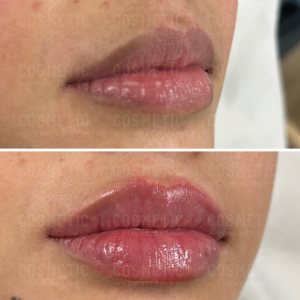
Before and immediately after lip treatment demonstrating initial swelling.
For the complete day-by-day breakdown, see our guide to swelling after lip enhancement treatments.
Lip filler aftercare
In the first 24 hours: avoid exercise, alcohol, heat, and direct pressure on the lips. In the first 2 weeks: avoid dental procedures requiring lip retraction, high-impact exercise, and facial treatments applying pressure to the lip area. Attend your 2-week review appointment. For the complete aftercare guide, see our post on lip filler aftercare.
Lip filler migration: causes and prevention
Lip filler migration occurs when hyaluronic acid gel moves above the natural lip border into the perioral tissue. It is caused primarily by excessive accumulated volume over time and incorrect injection depth. It is uncommon with conservative volumes and correct technique, and is fully reversible with dissolution. For the complete guide, see our post on lip filler migration.
Who performs lip filler in Australia?
In Australia, lip filler is a prescription-only substance regulated by the TGA. It must be prescribed by a registered medical practitioner and administered under appropriate clinical supervision. Under AHPRA guidelines updated in 2023, a doctor-led model — where a registered doctor is responsible for each patient’s clinical assessment and treatment plan — is the expected standard of care.
Cosmetic Connection operates doctor-led lip filler services at its St Leonards, Sydney and Toorak, Melbourne clinics. Every treatment plan is developed by a registered doctor using a suitability-first approach. Flat-fee pricing applies across all treatments.
Lip filler in Sydney and Melbourne
For location-specific guidance on finding a qualified lip filler provider, see our dedicated posts on lip enhancement in Sydney and lip enhancement in Melbourne.
Common myths about lip fillers
Myth 1: “Lip filler will permanently stretch out your skin”
The Reality: When well-administered in conservative amounts, the treatment slowly metabolises over 12 to 18 months. As it breaks down, the skin naturally snaps back to its original baseline. There is no clinical evidence that proper lip treatments leave the lips looking deflated or stretched out once the product wears off.
Myth 2: “Getting lip filler always results in ‘duck lips'”
The Reality: An unnatural, over-projected look (often called “duck lips”) is the result of poor technique, excessive product volume, or filler migrating due to improper depth. It is not an inherent trait of the treatment itself. When placed accurately by an experienced injector using an appropriate upper-to-lower lip ratio, lip filler remains soft, flat, and completely proportionate to the rest of your facial features.
Myth 3: “If you don’t like it, you just have to wait a year for it to go away”
The Reality: You are never stuck with a result you do not want. Because modern lip fillers are made from hyaluronic acid, they are fully and rapidly reversible. By injecting a targeted dissolving enzyme, the gel can be dissolved easily, returning your lips to their natural pre-treatment baseline within 24 to 48 hours.
Myth 4: “Lip filler and a lip flip are the exact same thing”
The Reality: While both target the lips, they use entirely different mechanisms. Lip filler uses a physical gel to add volume, structural shape, and definition. A lip flip temporarily relaxes the muscle around the mouth, allowing the top lip to gently roll outward. A lip flip changes the illusion of the lip height when speaking and smiling without adding any actual volume.
Frequently asked questions
What is the difference between lip filler and the lip flip?
Lip filler uses hyaluronic acid gel to add volume and shape to the lips. The lip flip uses a small amount of neuromodulator injected into the orbicularis oris muscle to relax the upper lip and cause it to evert slightly — creating the appearance of a fuller upper lip without adding volume. The lip flip produces a more subtle result and lasts 6 to 8 weeks. Both can be combined.
How long does 0.5ml lip filler last?
0.5ml lip filler typically lasts 9 to 12 months. Lower volumes break down faster than higher volumes in absolute terms, because there is less product to metabolise. Individual metabolism, product type, and lip movement patterns also affect duration.
Can lip filler look natural?
Yes, when performed with the right volume and technique for the individual anatomy. Natural-looking results are the norm in well-governed clinical practice. Unnatural results are the product of excess volume and incorrect placement, not of the treatment itself.
What is the Russian lip filler technique?
The Russian technique uses a vertical injection approach that creates central projection and height in the upper lip, producing a pronounced cupid’s bow and heart-shaped appearance with less lateral spread. It requires advanced training and is not anatomically appropriate for every patient. Assessment by an experienced practitioner is necessary before this technique is recommended.
Does lip filler hurt?
Most patients find lip filler manageable. Topical numbing cream is applied before treatment, and most lip filler formulations contain lidocaine — a local anaesthetic — within the product. The procedure takes 10 to 20 minutes. Mild tenderness in the first 24 to 48 hours post-treatment is common.
Can I get lip filler while pregnant or breastfeeding?
No. Lip filler is contraindicated during pregnancy and breastfeeding. There is no safety data for hyaluronic acid injectable treatments during either period. Responsible clinics will not perform lip filler on patients who are pregnant or breastfeeding.
What happens if I stop getting lip filler?
The hyaluronic acid breaks down naturally over 12 to 18 months. If treatment is discontinued, the lips return progressively toward their natural baseline as the product metabolises. There is no credible clinical evidence that well-administered lip filler causes permanent negative structural change to the lips over the long term.
How soon before a wedding or event should I get lip filler?
Schedule a first lip filler treatment at least 2 months before an event. This allows 4 weeks for settling, and a follow-up at 4 weeks with enough time for an adjustment or touch-up if needed. Do not have a first lip filler treatment within 4 weeks of an important event.
Can you get lip fillers if you suffer from cold sores?
Yes, as long as you don’t currently have active cold sores (HSV), you can get lip fillers.
What is lip filler dissolving and when is it done?
Lip filler dissolving uses hyaluronidase to break down the hyaluronic acid gel and return the lips to their natural baseline. It is used for emergency vascular management, aesthetic correction of unsatisfactory results, and pre-treatment clearance of accumulated product. Results are visible within 24 to 48 hours. See our full guide to reversing lip enhancement treatments.
How do I make lip fillers last longer?
The three proven ways to make lip fillers last longer are to have higher volumes, use a more cohesive (thicker) filler, and have consistent maintenance. All methods increase the time it takes for your body to break down the filler. No other methods are proven to increase lip filler longevity.
What happens when lip fillers wear off?
When lip fillers wear off, your lips revert to their natural shape and size.
How long to wait between lip filler treatments?
It depends. When building your result, you may need a few sessions in a short period of time, typically over 2-3 months. For maintenance, 1 treatment per year is usually sufficient.
How do I find a good lip filler provider in Australia?
Confirm a registered doctor is involved in your clinical assessment, hyaluronidase is on-site at every appointment, a genuine consultation precedes treatment, pricing is transparent and flat, and a 2-week follow-up review is included. For Sydney-specific guidance, see our post on lip enhancement in Sydney. For Melbourne, see our post on lip enhancement in Melbourne.